
Part Four: When Release Becomes Renewal
Alberta Stevens
Dear Friend,
As we close this four-part series on Releasing the Inner Critic, I wanted to offer one final window into the work of naming, loosening, and renewing the stories that shape us. This piece gathers the threads of the journey so far and invites you to settle into a slower, steadier rhythm as the year draws to an end.
Part Four: When Release Becomes Renewal

Understanding the Work of Release
The purpose of learning about the critic or any limiting inner voice is not simply to silence or erase it. Rather, it is about learning to understand what kind of voice we are dealing with so we can discern the strategy to take forward. The root of the voice determines the strategy. This is where the spectrum discussed in part 1 returns.
If the critic is a grieving or frightened part of the self, then perhaps compassion is what is needed. If, however, it is an over-functioning protector, like Gallwey’s Self 1 or Mohr’s cautious inner critic, then a gentle redirection may be the best approach. If, on the other hand, you find yourself battling against a full saboteur, the kind Carson Meyer warns against, then you might want to meet such a voice with equal firmness and resistance.
When the critic echoes the trauma-born voices—external accusations that have become internal law—the work is neither mockery nor suppression but story excavation: separating what belongs to us from what was imposed upon us. This story-formed approach finds its roots in Nick Drake’s narrative coaching methodology. Brené Brown’s Rising Strong process mirrors a similar approach where healing begins with recognising the story we are telling ourselves, rumbling with its origins, reckoning with truth, and rewriting our narrative in grace.
The key point I am driving at here is that there is no single formula to the way we engage and dismantle the critic’s effect on our lives. The way we engage depends on how we identify the critic, the language we give it, and the context we are working within. In my own practice, this discernment is featured in three core building blocks of all my coaching conversations: context, capacity, and contribution. To determine the direction of travel, we begin with where the client stands, context, what they can hold, capacity, and finally, where they long to go, contribution and legacy. In order to begin to loosen the effect of the critic, we have to first understand its patterns. We notice and we name, we understand the effect it has on us and begin to loosen its grip before we move forward into releasing it.
As we step into the work of releasing, it is important to remember that the goal of learning about the critic is not to build a perfect self who never hears that self-protecting inner voice again. Arguably, in some instances our inner critic has kept us safe and faithfully guarded us against hubris or self-deception. However, what I am suggesting we aim to cultivate is a simple rhythm of presence and renewal, the steady capacity to return to truth and vision when the limiting voice reappears.
The Rhythm of Renewal

This is why, in my transformational 5Rs Coaching Framework, Releasing is followed by Resting and Reimagining. Once the critic’s hold begins to loosen, we create the spaciousness to rest from striving and to imagine new ways of being. This rhythm of presence and renewal is what moves us from vigilance to vitality.
At this stage between release and rest, the work shifts from reaction to restoration. We learn to recognise the critic’s tone, separating its warnings from its wounds in order to build new pathways of self-trust. This is where we let discernment mature into wisdom. For some, it might mean returning to prayer or reflective solitude. For others, it might mean creative play, movement, or simply allowing joy to re-enter daily life without suspicion.
In The Inner Game of Work, W. Timothy Gallwey calls this returning to Self 2, the intuitive, embodied part of us that knows how to act without over-control. Whilst Tara Mohr speaks of beckoning our future self, our inner mentor, the wiser, braver self who leads from vision rather than fear. Both invite us to cultivate presence that is embodied, responsive and expansive, no longer tethered to the need for constant self-correction.
Living Beyond the Voice

When we live from this place of presence and renewal, we are no longer at war with the voice. We listen differently. We let it speak, but we do not let it lead. We respond with grounded awareness rather than defensiveness. We begin to experience a still awareness beneath the noise, a depth that holds us steady even when the surface trembles. In that awareness, we learn to take the risk of stepping into the water by faith, with our gaze fixed on the One who calls us into the deep. It is the steady presence that invites and reminds: we are not alone. We are seen, held, and called forward into the wide mercy of becoming.
For those whose faith forms a deep part of their story, this moment often feels spiritual—a realignment with grace.
It is the rediscovery of being held, even when the waters rise. In this space, we awaken to what Henri Nouwen called our truest identity: Beloved. We begin to remember that we were never meant to earn worth through perfection or performance. The voice of love speaks beneath them all, reminding us that
belovedness is not a reward but a reality.
To live from this place is to move from false self to true identity. The critic may still whisper, but its words no longer define the story. Renewal begins here, in the quiet acceptance that you are already seen, already loved, already enough. From this ground, presence expands, and the work of leadership, creativity, and faith becomes
an offering rather than a proving.
In my work with clients, I often describe this as learning to walk by faith or vision in alignment: feeling the instability of the waves and yet keeping your gaze fixed on the call that propels you forward. Presence is not achieved once and for all; it is renewed each time we choose faith over fear, courage over control, and joy over justification.
Seated in presence, when the critic returns—and it will—it will no longer announce failure. It will signal that you are stretching again, that growth is underway. The voice becomes a reminder to breathe, to ground, and to return to what you know to be true and possible.
Reflection and Renewal

Before you move on, let’s take a moment to look back on the track covered so far.
So far in this series, we have named the critic and begun to locate where it lives in you—whether as a fearful protector, a perfectionist judge, a weary voice of comparison, or a saboteur whispering that safety is better than freedom. We have learned to see how it shows up in our bodies: the tightening chest, the shallow breath, the dimming of joy.
Now notice what shifts when you bring it into light.
When you name the pattern, you reclaim power.
When you locate its place on the spectrum, you discern your strategy—whether to soothe, reframe, excavate, or resist.
And when you release it, you make space for truth to speak louder and for your expansive future to emerge.
A Practice to Begin: The Four Movements of Release and Renewal
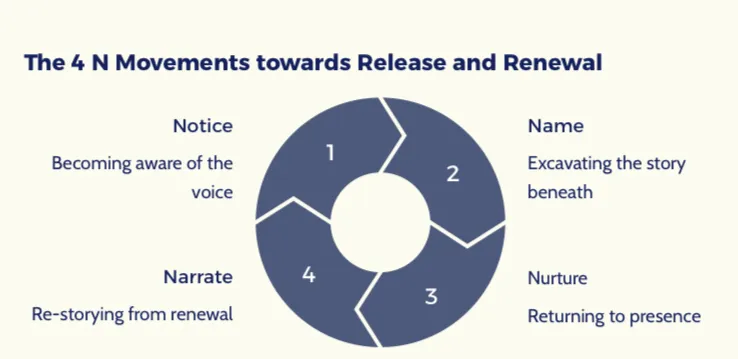
As we move through the middle ground between letting go and renewal, here are four inner movements I have developed that could help you meet the critic with awareness and grace.
They sit quietly within my transformational 5Rs Coaching Framework — Releasing and Resting — forming a bridge from struggle to stillness, from vigilance to vitality.
1. Notice
Begin by slowing down.
Pay attention to when the voice appears and how it feels in your body.
Does your breath shorten? Do your shoulders tighten? Does your mind replay an old warning or fear?
Noticing is witnessing, observing without analysis. When you begin to easily notice the moment, the pattern and tone, you loosen the critic’s invisibility and begin to reclaim your centre.
2. Name
Now, gently give language to what you have noticed.
What story is this voice repeating?
Whose standards or fears does it echo?
This is the excavation stage — where you trace the roots of self-doubt, imposter feelings, or perfectionism without judgment. This narrative approach reminds us that healing begins with naming what is before rewriting what can be.
3. Nurture
Having named the voice, step back and nurture what is tender.
Return to your rhythm of presence to self-nurture.
Seek what brings you joy or inspires wonder — this could be journaling, prayer, movement, beauty, stillness, time in nature, and so much more.
Let the quieter, hope-filled voice, the one that speaks of possibility, truth, and belonging, rise again.
This is where you remember who you are beneath the noise, where your breath lengthens and your gaze softens toward yourself.
4. Narrate
From this grounded place, begin to re-story your life.
Write a single sentence that begins, “This is who I am now.”
You could expand your story by writing statements that remind your critic of your new identity “I no longer need to be protected from… (insert what applies).“I have what it takes to do…(insert playing big moment).
Let the story that emerges not be a correction but a remembering — a re-visioning of your truest self, grounded in grace and hope.
You can move through these four movements in a single sitting or return to them slowly across days. The 4N Movements are not mechanical techniques to master but rhythms to inhabit — each one drawing you closer to the quiet centre where release becomes rest, and rest becomes renewal.
Final Words

If this reflection finds you somewhere along that journey, I encourage you to return to Parts One, Two, and Three. Read them slowly. Let the insights meet you where you are today.
The critic is not conquered in a moment; it is observed, reframed, and gradually released through awareness, self-nurturing, and the courageous practice of renewal.
Each act of noticing loosens its grip.
Each breath of courage strengthens presence.
This is the work of renewal: to live fully, imperfect yet whole, steady in the storm,
awake to the beautiful vision that calls you forward.
Closing Invitation
If this reflection resonates with where you are in your own journey, you might want to:
1 . Download the free Reflection Guide: The 4N Movements of Releasing the Inner Critic, which expands on these four movements with deeper questions and practices, when you register for the masterclass.
2. Explore the Releasing and Resting phases of my 5Rs Transformational Coaching Framework through a
30-minute complimentary discovery call
Thanks for reading!
With grace and courage,
Alberta